
Updated: Apr 27

At a dinner party recently, I was asked to explain the design process for my ACCCE social impact projects. Between fork clanks and soft music, I did my best to share the gist of it all. And in the process I realized the design process can seem a bit confusing. So in this blog post, I'll share a bit about the design process through the story about a poster series I created last year for the local Windhoek SPCA. You'll learn how projects get started, what you can expect from a design experience and how to hire me - plus cute little doggo illustrations as we go along!
...
A quick introduction - SPCA is the Society of Prevention of Cruelty to Animals and it exists almost worldwide as an NGO that cares for and rehomes stray or abandoned pets. I love animals and enjoy a bit of volunteering, so I signed up as a volunteer as soon as we arrived in country. And I've been on the regular volunteer roster at the SPCA ever since! (If you want to read more about my volunteering, you can head to blog post No 22 Dogust from 2023.)
Oh, and if you don't know me already, hi, I'm Smarti and I'm an illustrator/graphic designer. I believe in the power of social impact so I offer my services at reduced rates to NGOs and social impact initiatives under the ACCCE umbrella (Animals, Conservation, Culture, Community, Environment). Sometimes the funding is paid forward from other willing clients, which just further reinforeces the idea that we can all do good when we work together.
I rock up to the SPCA every week to volunteer for a couple of hours. I like to suit up in flight suit coveralls and bring treats in a small waist pack. Once inside, I check in to as many kennels as I can. There are over 20 kennels fit for volunteer access, and each one has two dogs in them. So I let myself into their kennels and cuddle, train and play with these puppers so they can get more habituated to humans before adoption.
At the end of my session, I fill in a time log at the front office and the staff sign off on the hours that I served. (They use that info later for statistics, fundraising, etc.) This is also how the staff gets to know the volunteers and their skillsets. (Fun fact, last year I clocked in over 200 hours so the dog director gave me a puppy perk. She let me "borrow" a soft, white 5-month old rescue named Lulu to attend puppy school so I could learn more training techniques. Lulu got adopted a few months later and I hear she's doing really well in her new family!)
Over the year as I passed in and out of the office, the director and I would meet and chat casually. Eventually, she pulled me into her office to talk about my creative work. I got to share some design stories and walk her through my portfolio on my website. As her tenure was coming to a close, she told me about a dream design project she had been hoping to create and how I would be the perfect designer for it! I told her I would be excited to hear more and asked her to send me an email to formalize the project hire request.
We had a first social meeting, just going for a hike with her pup so we could get to know each other. (I'm very lucky - I always seem to have fun social calls with my clients.) From there we started to talk about what the project could be. I asked her all the common questions:
who is it for?
what is the purpose?
why is it important?
when does it need to be finished?
She decided to develop a public awareness pet care campaign series, printed as posters or in the SPCA newsletter. She listed out a series of topics that would be the most important to share about the care of common diseases and specific concerns to pet-life in Namibia - ticks, rabies, etc. But also info about how to care for outdoor pets with the summer heat and winter cold specific to desert life.
She emailed me some previous poster designs, some content from other SPCAs in other countires and together we nailed down the reason for this project: to educate pet-owners and help SPCA Windhoek elevate their authority and integrity in the country. On the visual front, the key to creating this authority and integrity is through quality info, uniform poster design and cohesive branding.

Once the contract was set and the deposit paid, I moved forward into the research phase. To start, I dig into the visual pieces provided - like the posters. I spend a lot of time analyzing all the elements - typography style, the colors, layouts, language tone, etc. I like to write down the impression that the choices create so I can make sure that a) they are being consistent throughout the branding and b) I can see the patterns I need to follow to make the next series match the branding.
This is also where I start to find anomolies with clients, specifically "who they think they are" vs "how they actually present themselves." Sometimes I have to ask my clients some hard questions about visual identity. It often takes introspection and an understanding of visual nuances. Certain colors, illustration styles or language change the branding tone. So I try to be gentle, helpful and educational as they figure out what they decide what they need to express with their branding and/or the project's visual identity.
Alongside this, I also had to start compiling the copy text. Normally for graphic design projects, the clients give you copy text (their info, their sales pitch, their language) and you paste it in to the poster/brochure/grant proposal, etc. But for this illustrated poster series the director hired me to also do the research to build up the copy text.
Although tedious, it was actually helpful for me to do the research so I could brainstorm what things would be appropriate to illustrate for each of the poster topics. I read veterinarian medical articles, gleaned over wikipedia disease listings, watched videos (seeing animals suffer from diseases was heart-breaking) and searched for pictures and reference materials. I compiled all of the information in a google doc on each of the 12 separate topics and sent it to the director. Once she sent some edits, I was able to move forward with the design concepts.
Finally, choosing concepts - where the inspirational brainstorm begins! Yuppee! I typically have an idea of what I think will work - in this case two-tone designs. But I also love to scour pinterest to find some inspiration. Sometimes these inspo pieces have NOTHING to do with the project. But something in the search helps to unlock creative space in my brain. An illustration style, a color palette, a funky layout. That helps me break out of the routine and inspires ideas to make it extra special.
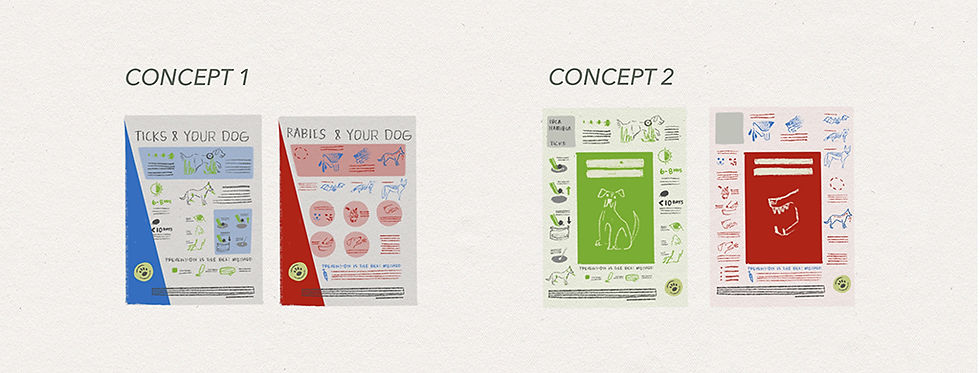
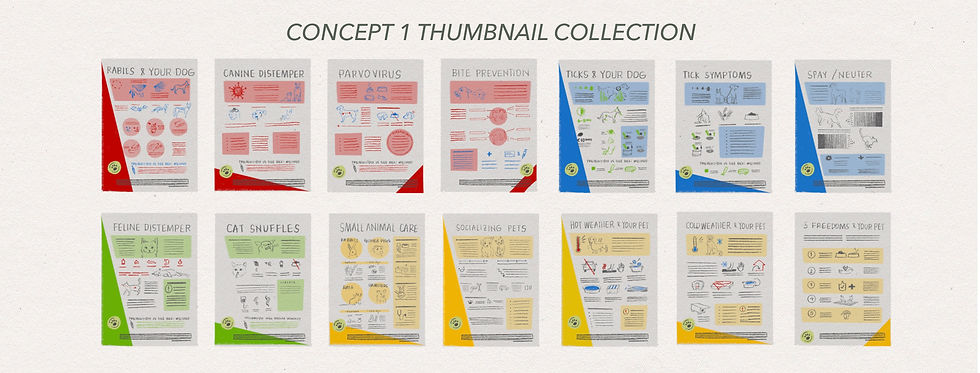
I crafted two concepts in two thumbnails each - four posters in total - to send to the director. The first concept was designed so the poster could be folded up into a squarish pamphlet, or cut up into bite-size pieces for social media IG. The second concept mimicked a colored angle element used in other branding material to give a slanted edge to the poster design. The director decided to go with the second concept to reinforce the branding material. So I fleshed out 10 posters remaining in the series into thumbnail sketches in the same style.
I'll be honest, at the end of this phase I hit a bit of burnout. Building the copy text was draining, and although the concept design work is invigorating, it was a lot of work to build out the rest of the posters. Now, past-Smarti would just muscle through the pain, but I've learned that my inner muse comes back quicker when I honor deep rest. So I try to ask for time extensions when I feel tired like this. (Note to self: this is a pattern. I need to start building a rest buffer between concept design and final deadlines on big projects like this to give space to decompress between intense phases. Maybe 20-30% more time.) Thankfully the director was fine with me needing to pause the project for some rest, and she agreed to reset the contract terms and deadlines.

Once revived, I set up the poster files in Adobe Indesign software and started to assemble the color block layouts and text boxes. While some of the layouts were similar, each poster was different. Some of the posters had side angles, or circles, or blocks for texts, so I often had to ignore the grid or shift text to fit around the space blocked out for the illustrations. It took a lot of jiggling to get each poster to look tidy and organized.
I decided to give each poster one main color illustration which meant sketching, painting and finalizing 12 drawings in full-color. I specifically chose to illustrate some of the local dogs and cats that were listed at the time in the SPCA. There are so many cute pets that are rescued in the system, so I pinned the adoption page on my browser as a helpful reference to understand body shapes, fur patches, ear heights, etc. throughout the sketch phase. The shapes and bodies of dogs and cats change from breed to breed. So there were a lot of different shapes to try before figuring out the best shapes and poses.
The pet painting process took a learning curve. I've never painted fur before so I got quite carried away using several different techniques to make the fur patches believable. In the end I had to pull back because the painting technique mismatched with the comic illustration style that I was able to achieve. So I scaled back the details and used a blending brush instead to create outlines for body shapes. That seemed to do the trick. Once I nailed down at least three of the color illustrations, the process became easier and I painted each successive one faster.
Drawing of a brown chihuahua and boerwoer dog sitting side by side illustrated by Smarti. Drawing of a grey cat in pounce position illustrated by Smarti. Drawing of a brown dog and grey striped cat turning back illustrated by Smarti. Drawing of a brown and white puppy next to a grey little kitten illustrated by Smarti. Drawing of a grey and white husky illustrated by Smarti. Drawing of a calico dog and cat sitting calmly illustrated by Smarti
The last detail to sort were the 63 small black ink sketches I designed for the infographic details. A grainy pencil style felt right so I could give a personalized texture to the images and soften the info-heavy posters . Thankfully, I already had hand-drawn sketches from the thumbnails to reference so I quickly whipped up the last of the sketches in a couple of hours! I spent a day or so lining up all of the illustrations with the text.
After all the work it took to make the copy text and organize the graphic design elements of poster layout, I was surprised at how fast the illustrations came together. Maybe it was using a different part of my brain? Maybe I'm happier doing illustration work? Maybe it was just easier for some reason. Who knows. All the same, I'm grateful for the all the time and dedication I put in to illustration skills so that they are easier and easier to access.
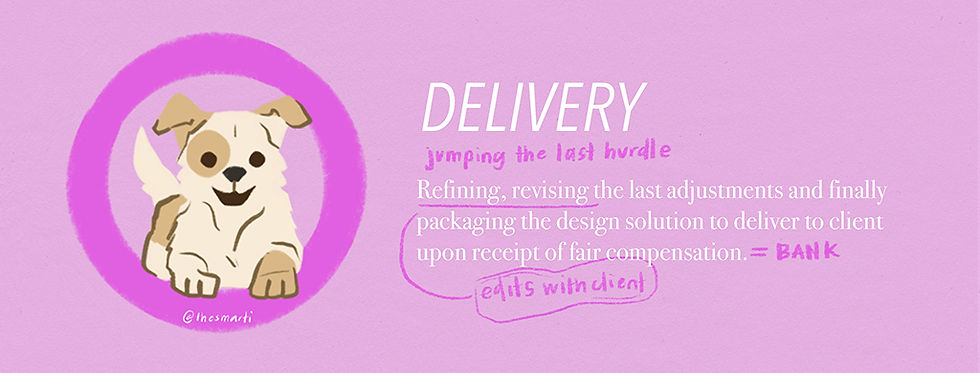
The director and did 2 rounds of live edits and 1 final email edit list before the series was complete. For the live edits, we set up a Zoom call and I shared my screen so we could go through each poster and revise things on the fly. She had already marked up all the edits we needed to make, so we just went through her list. We edited texts, fixed illustration colors, changed sizes and layouts of the sketches, added in transparency layers, and reformatted the bottom branding text.
Once the final edits were complete, I packaged the file in an Adobe Indesign folder and sent it via WeTransfer so the director could download the files directly to their servers. The director sent me the final payment for the work and prepared a review of the process and my services. She was even kind enough to send a reference to help me connect to another NGO who is interested in my work!
These posters appear in the SPCA monthly newsletter as a dedicated series to share with members of the community. Although they are in full color, some of the posters have been recolored into greyscale for black and white printed versions. They weren't designed for that contrast, but they still work and I'm glad they are serving their purpose.
Drawing and design of SPCA Your Pet and Ticks poster by Smarti. Drawing and design of SPCA Socializing Pets poster by Smarti. Drawing and design of SPCA Canine Distemper poster by Smarti. Drawing and design of SPCA Rabies Awareness poster by Smarti. Drawing and design of SPCA Cat Snuffles poster by Smarti. Drawing and design of SPCA Bite Prevention poster by Smarti. Drawing and design of SPCA Cold Weather & Pets poster by Smarti. Drawing and design of SPCA Parvovirus poster by Smarti. Drawing and design of SPCA Small Animal Care poster by Smarti. Drawing and design of Hot Weather & Pets poster by Smarti. Drawing and design of SPCA Feline Distemper poster by Smarti. Drawing and design of SPCA Spay and Neuter poster by Smarti.
...
This project started after a string of casual interactions with the director. Sometimes that's how it unfolds. But projects have also started after live-draw events, illustration swaps, friend introductions and email inquiries. Each time there's a bit of a get-to-know you phase so we can determine the project and if my skill set in graphic design and illustration style are the right fit. If you're here, and you've got a project in mind, you are welcome to reach out and say hello - it could be the start of a great project.
And now you know based on this project and many others on the blog,what it's like to work with me. From 1) ideation, 2) research, 3) concepts, 4) design and 5) delivery - the process is similar for each design experience. It's just the topic and breadth of the work that changes for the project and the client's needs. In this case it was a privilege to get hired to work on this poster series to support the SPCA and all the great work they do in the community!
cheers to getting hired to do good work for furry friends,
smarti

I love designing games and in the past couple of years, I've personalized two board games for friends that I'd love to share here. The design process is very enjoyable because each personality requires a different game and the process of crafting a game feels like an intimate dive into their lives. Read on to learn how I interview, brainstorm and designed these board games.
...
I have already shared before how I am a designer who enjoys making card games (here) and treasure hunts (here and here.) So it's no surprise that I would eventually get around to crafting personalized board games. Both of these games came about in anticipation of special events. I like how each board game honored the person in a very unique way.

Arpita Surprise game design © thesmarti
One of the darlings in my friendship circle loves prank surprises. She's incredibly gentle and sweet, so it was a bit of a shock to learn she finds pranks hilarious. (Think pies in face, midnight birthday pajama pop-ups, surprise visits, throwing a bucket of ice on a friend, etc.) To be honest, pranks make me nervous and sad, but I don't want to yuck anyone's yum and I can respect that it's integral to her cheeky personality.
For her birthday game board, we did a long interview with a whole range of questions about her life, her best stories and her favorite pranks. She pulled back the layers a bit to explain why she finds pranks special: it's the ultimate novelty of the unknown. Reactions and hidden feelings are revealed and the prank lets her share very random moments with family and friends.
After the interview, the game board idea came together rather quickly. A simple path alternating pick-up card for three different stacks - choices, stories, and pranks. Choice cards featured multiple choice answers to guess her likes/dislikes. Story cards listed the components of her best life stories so the player could string a convincing story together and guess the truth of the actual situation. Prank cards featured silly pranks that either propelled the player forward or backward. I made the prank cards gentle (toy soldiers in bed, googly eyes on every picture frame) and they were sweetly funny.
To decide on the card designs I asked Arpita to take a photo of her favorite sari designs. She sent me a bunch of different pictures and I pulled out a color palette from the references. I drew in and colored the game path, a space for cards, and personalized a little portrait of Arpita for the board. The cards were quickly lined up in InDesign with prompts straight from my interview notes. Print, cut, stack and the game board was ready in time for her birthday dinner. In hindsight. I would probably rearrange the path tiles for a bit more variety in the path. (For some reason the dice kept falling on the same number so we all had a bit of deja vu with the game.) In the end, the best surprise was that the person who got prank cards the most was the one who eventually won the game! Pranks for the win, eh?
...

How Well Do I Know Dennis game design © thesmarti
The second game came about when a friend called me up to help design something for her husband. She was arranging a tour through Namibia for his MBA colleagues who are known for sharing deep stories and vulnerable moments (hooray for male emotional intelligence!) So she asked me to make a card game that they could play one night together.
I was so intrigued by the idea of a circle of men being interested in each other's stories. (Male friendship research shows very low rates of intimacy in comparison to women friendships.) So for this special group of friends, I thought a board game about his life would be ideal.
Since the board game was a quick surprise, I had very little time to interview. So instead of specific questions, I quickly whipped up a list of 50 open-ended questions and emailed them to my friend so she could cross of the ones she didn't like. The questions ranged from adventures in his childhood, his school years, his adult life and even his current job. The goal of the game would be to see which friend actually knew him the best and could answer the open-ended questions the best.
Then I designed the board with a line of path tiles, a quick portrait illustration, and a block for the cards. The cards were copy-pasted from the email with a simple back cover block color design with the game name. Print, cut, fold and packaged in an envelope. Quick, easy, simple and easy to travel with. The game itself was played at a camp site and my friend told me later that it was a perfect end to a lovely road trip for this friendship group.
...
Making a custom board game is a fun way to get close, vulnerable and playful with friends. It helps to build new memories and unlock new levels in your friendship. I love making games like these - especially for deep connection among friends. Let me know if there's a game you'd like to create.
Cheers to crafting unique games to play,
smarti
Updated: Feb 16

Back in 2024, I landed a totally unexpected and wonderful project: illustrating animations for an ecological documentary. The director was looking for an illustrated solution and I got connected as a creative despite having zero experience doing animations. Chalk it up to having really good friends! So, I rolled up my sleeves and the client was gracious. I'm finally getting around to sharing about this special experience. Read on for a real juicy process blog.
...
I've never done animations before. Ever. But I had it on my dream project list, and I had played around making animations in Procreate. Which creative hasn't, right? So it was fun to receive a query from a friend who connected me to the project - would you ever be interested in doing illustrated animations? And once I said "ooh yes!" I received a preliminary email of the general brief: title, name plates, locations, credits, explaining graphics for a film on farming practices and soil health. A cool project about the health of the planet? Yes, please!
To wrap my head around the project, I proposed a series of graphic styles just to gauge the client's aesthetic and actual interest. (Isn't it always so exciting in the beginning, when you don't really know whats happening or even if the project will align with your skills?) Having the client give me their style choices gave me some direction, and provided me with limitations that helped me start to see what the project might look like. In hindsight, I probably shouldn't have started with style choices because it kind of forced a style that wasn't as suitable once we got to the end of the project. ::sigh:: But a little naïveté is always best at the start of a daunting project.
Pumped and peppy, I bounced into the first 1:1 meeting wih the producer to talk about concepts for illustrations. Together we tossed a bunch of creative ideas into the air which I turned into some quick illustrations. Afterwards, I expanded the best ones into some colored illustrations to present to the colorist and editor. You can see how I was already trying to bridge the introduction and finale of the documentary - using the same imagery and style. You know, building a full-circle concept to see if the style would really work.
Illustrated notes of the original title of the documentary Lanad Jord by illustrator Smarti. Ink drawings of conceptual elements for Lanad Jord by Smarti. Illustrated doodles of conceptual ideas to describe earth waning from overfarming by Smarti.
(1) First client call sketches, (2) conceptual ideas (3) doodled conceptual ideas © thesmarti

Colored designs to present to the colorist and editor © thesmarti
Once the team picked the illustrations that translated the concept best, I attempted an animation reel in Procreate to see if this could work. This was one of those scary moments. I mean, who hasn't been in awe of animators. But I suddenly appreciated how the frame rate expands the concept into millions of small line decisions. It humbly took me more than 20 hours to make this silly 5sec thing. And it wasn't even that good. I lost steam at the end of the animation and ran out of time. I cried to my partner that night out of sheer panic that I had no idea if I was actually going to be able to pull this off! Thankfully, the producer saw potential in everything I did (I always seem to luck out with generous clients) and he gave me continual encouragement as I fumbled along.
Illustrated animation screenshot 1 of earth by Smarti. Illustrated animation screenshot 2 of earth's air catch valve by Smarti. Illustrated animation screenshot 3 of earth's air catch valve leaking air by Smarti. Illustrated animation screenshot 4 of earth's air catch valve leaking more air by Smarti. Illustrated animation screenshot 5 of earth's air catch valve deflating by Smarti.
The first animation test "Deflated Earth" © thesmarti
Eventually, the project solidified and the schedule fell into a groove. The producer outlined 7 separate animations reels, with clear scripts:
1. Introduction: About the Earth
2. Eutrophication
3. Erosion
4. Humus
5. Cover Crops
6. Agricultural History
7. Conclusion: Circular Agriculture.
Every week, I'd finalize one of the animation, do some research (I learned so much about soil health!) and then propose the next week's storyboard for approval. And we moved from one animation to the next over a period of 2 months. I stuck with Procreate, because although I had done some previous work in After Effects, I remember being stymmied by the crispness of the Adobe Illustrator vector designs. In Procreate, I could draw textured pieces faster with my ipad and then figure out how to animate them intuitively.
Photograph of script notes for the entire project. Hand-drawn illustrated frames for "Eutrophication" script for eco-documentary by Smarti. Illustrated frames for "Cover Crops" script for eco-documentary by Smarti. Close-up of illustrated frames for "Cover Crops" script for eco-documentary by Smarti.
(1) scripts for the entire project, (2) my illustrated script for "Eutrophication" (3) cleaned up script on "Cover Crops after a video call meeting and (3) closeup on pink notes for the script for "Cover Crops" © thesmarti

Conceptual design illustrations for script of "About Earth" © thesmarti
Illustrated elements of farm items like baskets, crops by Smarti. Illustrated elements of farm items like animals and tractors by Smarti.
Elements to animate and illustrate for script of "Agricultural History" and "Circular Agriculture © thesmarti
To be frank, the animations never got easier. It took me whole days to make 3 seconds of material! Crazy. Even though Procreate was intuitive, it broke my head to map out the frames, and decide when lines would need to appear or move or fade. I'm so used to static illustrations that it was a whole other beast to make the illustration move convincingly. Making things speed up or slow down was beyond my calculations. I made loads of mistakes, investing in animating a sequence only to decide hours later that it didn't work. Then I'd have to regroup and plunge back in to try a different idea.
Animated first version for the script of "About Earth" © thesmarti
By the time we finished the first round of animations, I needed a break. This was important because I was getting almost angry with the project. I started feeling dread when I would have to figure out the pieces, and then a strange relief and short-lived elation that I had somehow pulled it off...just in time to start on the next concept! I also think the tension was because I had to drop a lot of other client work. The animations required so much time and energy that I needed to dedicate all my attention on it. I had an "aha" moment on this project that a variety of work keeps me healthy and happy. A lesson well-earned.
But after a 2-week trip (we took a quick local flight to Victoria Falls to gawk at the water and wildlife), I felt refreshed enough to start the second round of animations. This is when the producer talked me through each animations and requested some changes - different colors, replacing some objects, accelerating parts, slowing down others. By now I had the voice-overs which were in Swedish which isn't the same as Danish but I still thanked my lucky stars I had learned some similar key words and phrases! Even better, I also had some estimated time stamps so I could attempt to sync the animations with the voice-overs.
I had learned from previous projects that both clients and I can have unrealistic expectations of the workload with edits. So I try to make sure that at the end of a project I either get priorities or extensions (or both) to make sure I can deliver the necessary changes. In the case of this project, I knew that expanding from 2-frames per second to 8-frames per second was going to literally quadruple my workload. So I had to limit the changes. And the producer did his best to create space for extensions so I could meet the deadline with the best work possible.
By this point, the project was using the animation reels as projected images onto filmed macro-shots relating to the animation reel subject. So I was submitting them on transparent backgrounds and once I saw the mockups - in my horror I realized I needed to solve some visual hierarchy problems! Basically, the moving elements in the macro-shots were more saturated than my illustrations. So it was hard to see or pay attention to the illustrations. And the whole point was to understand the concepts via illustrations! So I needed to oversaturate the illustrations in edits so that they wouldn't get lost in the macro-shot details.

First, I condensed small elements that would get lost in the busy background. Second, I repainted the colors on elements so they would contrast better with the busy background OR add in some visual tricks (like white blocks or transparencies) for the elements that couldn't be repainted because of consistency issues with other animations. Because each macro-shot created a different problem, I couldn't use the same solutions. I had to solve each one creatively.
I barely kept my head above water while churning out two new animations from modified storyboards, and then expanding 5 of the 7 animation reels from 2-frames per second vs 8-frames per second all while attempting to solve the transparency/visual hierarchy problems along the way. Procreate has a limit to the frames you can add, so I ended up making multiple parts for each animation. Parts 1-8 for a single 15 second reel! (They were combined together later as a whole sequence.) I raced to the deadline in time to upload the Procreate in multiple formats - Animated HEVC, Animated MP4, Animated PNG, and finally as PNG files so the colorist could put them in order himself to time-sync it exactly with the voice-over.
Animated final for the script of "About Earth" © thesmarti
I wish I could load all of the isolated files here, but you'll just have to forward to the time stamp to see each of the 7 animated illustrations in the documentary:
1. Introduction: About the Earth (01:36)
2. Agricultural History (05:12)
3. Erosion (07:07)
4. Eutrophication (07:28)
5. Humus (09:33)
6. Cover Crops (13:21)
7. Conclusion: Circular Agriculture (35:02)
Here are some screenshots so you can sneak peek some of the illustrated concepts:

Concept: Over-farming and depleting the soil, screenshot from "About Earth" animation for Lånad Jord © thesmarti

Concept: Cycle of Plants to Animals to Manure to Plants, screenshot from "Agricultural History" animation for Lånad Jord © thesmarti

Concept: Fertilizer Runoff Leads to Deadly Algae Blooms, screenshot from "Eutrophication" animation for Lånad Jord © thesmarti

Concept: How Cover Crops Hold Soil To Keep Farms Healthier, screenshot from "Cover Crops" animation for Lånad Jord © thesmarti

Concept: Decomposition of Animals and Plant Debris Create Humus, screenshot from "Humus" animation for Lånad Jord © thesmarti

Concept: Cover Plants Hold Soil, Push Out Weeds, Improve Soil, Increase Humus, Counteract Erosion, Deter Pests and Attract Good Insects, screenshot from "Cover Crops" animation for Lånad Jord © thesmarti
...
In the end, I have no doubt that this project helped me build tenacity. I used Procreate's simple animation software to make a complicated deliverable. One of those "I made what I could with what I had" and I know I tried my very best. Even still, I'm sure it was a headache for the colorist who had to put the pieces together and freeze some frames and reconfigure sections in the editing process. (Ah, editing! I'm grateful to you, Jonas, for taking on that challenge!) All in all, I'm so very proud of what I contributed, and I'm grateful that the whole team was gracious enough to make it work. I'll be cheering on Katagrama Productions in all their endeavors - what a fun team and what an interesting project to collaborate on!
The documentary Lånad Jord (Borrowed Land) is permanently published on the Royal Swedish Academy of Agriculture and Forestry site here as well as on youtube with subtitles in English.
here's to rising-to-the-ocassion and taking on new challenges,
smarti


